People who use drugs in Toronto have long advocated for access to drug checking in an effort to reduce the harms associated with using drugs from the unregulated supply.
Launched in October 2019, Toronto’s Drug Checking Service offers people who use drugs timely and detailed information on the contents of their drugs, helping them to make more informed decisions.
This drug checking service also helps to uncover the makeup of Toronto’s unregulated drug supply, which includes illegal drugs, as well as legal drugs diverted from regulated markets for sale through criminal channels. Information on Toronto’s unregulated drug supply is made publicly available.
How do I get my drugs checked?
Toronto’s Drug Checking Service is free, anonymous, and available to everyone.
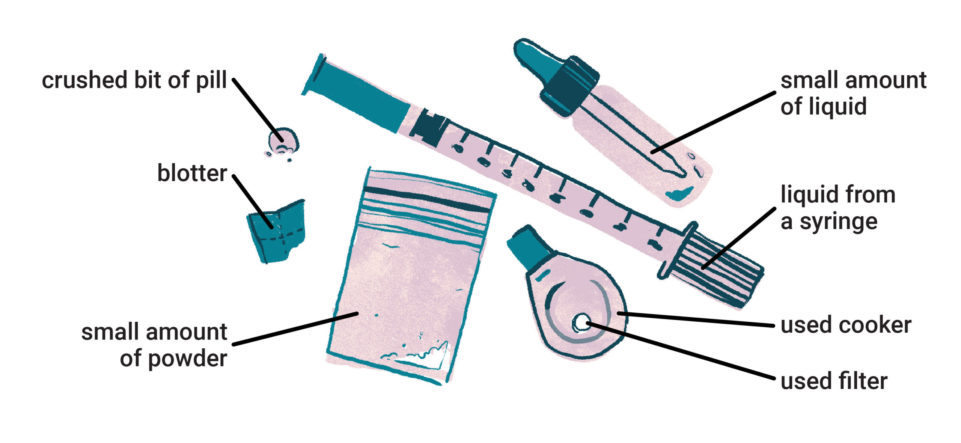
Accepted samples include drugs (10 mg of powder, crystals, rocks, or a crushed bit of a pill, a small piece of blotter, or a small amount of liquid) and drug equipment after it’s been used (a used cooker or filter, or leftover liquid from a syringe). There are some samples we do not accept, including organics – like cannabis, mushrooms, or anything THC-, CBD-, or nicotine-related – as well as hormones, steroids, vitamins, and performance enhancers (refer to our terms of service for more detail).
Samples are currently collected at eight community-based organizations in Toronto known as collection sites:
- Casey House – Jarvis and Isabella
- Fred Victor (145 Queen St. E Drop-in) – Jarvis and Queen
- Parkdale Queen West Community Health Centre (Parkdale site) – Dufferin and Queen
- South Riverdale Community Health Centre (Moss Park site) – Sherbourne and Queen
- Street Health – Sherbourne and Dundas
- The Neighbourhood Group (Kensington Market Overdose Prevention Site) – Augusta and College
- West Neighbourhood House (The Meeting Place) – Queen and Bathurst
Be sure to check a site’s hours of operation before traveling to use Toronto’s Drug Checking Service.
Results are both qualitative and quantitative (i.e., which substances are found in each sample and varying degrees of information about how much of each substance is present) and are available within a business day or two. Results are communicated to service users by staff from the collection site in person, by phone, or by email, along with tailored harm reduction supports, guidance, and referrals to drug-related, health, and social services (e.g., supervised consumption, naloxone training, primary health care) or can be accessed directly online by service users.
How does Toronto’s Drug Checking Service work?
Samples are transported from the harm reduction agencies where they are collected to a nearby laboratory at the Centre for Addiction and Mental Health or St. Michael’s Hospital, known as analysis sites, to be analyzed.
Toronto’s Drug Checking Service uses mass spectrometry technologies (gas and liquid chromatography). These sophisticated lab-based technologies offer detailed information about which substances are found in each sample, along with some information about how much of each drug is present.
This service operates by way of exemptions from the Government of Canada’s Controlled Drugs and Substances Act.
Who is involved in Toronto’s Drug Checking Service?
Toronto’s Drug Checking Service is coordinated by a small central team that operates from within the Drug Checking Unit at St. Michael’s Hospital.
Collection site members: Casey House | Fred Victor | Parkdale Queen West Community Health Centre (Parkdale site) | South Riverdale Community Health Centre (Moss Park site) | Street Health | The Neighbourhood Group (Kensington Market Overdose Prevention Site) | Toronto Shelter and Support Services (Harm Reduction Unit, formerly Seaton House Overdose Prevention Site) | West Neighbourhood House (The Meeting Place)
Analysis site members: Centre for Addiction and Mental Health (Clinical Laboratory and Diagnostic Services) | St. Michael’s Hospital (Department of Laboratory Medicine and Drug Checking Unit)
Partners and collaborators: Alliance for Collaborative Drug Checking | British Columbia Centre on Substance Use | Canadian Centre on Substance Use and Addiction | Centre on Drug Policy Evaluation | Four Counties Addictions Services Team | Fred Victor | Health Canada’s Drug Analysis Service | Health Canada’s Office of Controlled Substances | META:PHI | National Safer Supply Community of Practice | Office of the Chief Coroner for Ontario | Ontario Harm Reduction Network | Ontario Poison Centre | Ontario’s Centre of Forensic Sciences | Peterborough Public Health | Public Health Ontario | Registered Nurses’ Association of Ontario | Toronto Harm Reduction Alliance | Toronto Opioid Overdose Action Network | Toronto Paramedic Services | Vancouver Island Drug Checking Project
Funders: Health Canada’s Substance Use and Addictions Program | Ontario’s Ministry of Health | Public Health Agency of Canada | St. Michael’s Hospital Foundation | Toronto Opioid Overdose Action Network via Ontario Health
Toronto’s Drug Checking Service works closely with service users, and people who use drugs more broadly, to ensure the program meets the needs of the community it is intended to serve.
Acknowledgments
We acknowledge the members of our communities that have lost their lives – both in the ongoing toxic drug supply crisis and long before.
We acknowledge that racialized communities and survivors of colonization are disproportionately impacted by the toxic drug supply crisis.
We acknowledge that we operate on Indigenous land, which is home to many diverse First Nations, Inuit, and Métis peoples. Our program is coordinated from Toronto, which is the traditional territory of many nations including the Mississaugas of the Credit, the Anishnabeg, the Chippewa, the Haudenosaunee, and the Wendat peoples.
We know that many of the samples we check are linked to fatal or non-fatal overdose, as well as adverse health events – we acknowledge the people and pain behind the data we share.
We acknowledge that our work is only possible – and we only have access to this data – because people who use drugs donate their drugs to our program in an effort to reduce the harms associated with using unregulated substances and facilitate community-led drug market monitoring and education. We are incredibly fortunate to be trusted by people who use drugs throughout Ontario.